





Life and Livelihood: An Ethnographic Study of Tribes of Western Ghats, Kerala
This presentation provides an ethnographic account of the Aranadan tribal community in Nilambur Valley, Kerala, exploring how socio-economic shifts impact language attitudes and cultural identity. It investigates why the community continues using their mother tongue, Aranadan, despite external pressures favoring Malayalam. The study, based on fieldwork in several tribal regions, uses interviews and participant observation. Findings reveal that while traditional spaces like festivals strengthen identity, deforestation and housing policies often ignore cultural values. Education, livelihood challenges, and media influence are shifting youth language preferences and reinforcing stereotypes. The research stresses the need for government-sensitive interventions, including appointing community speakers and creating inclusive classrooms, to support cultural and linguistic sustainability.
Watch the Video

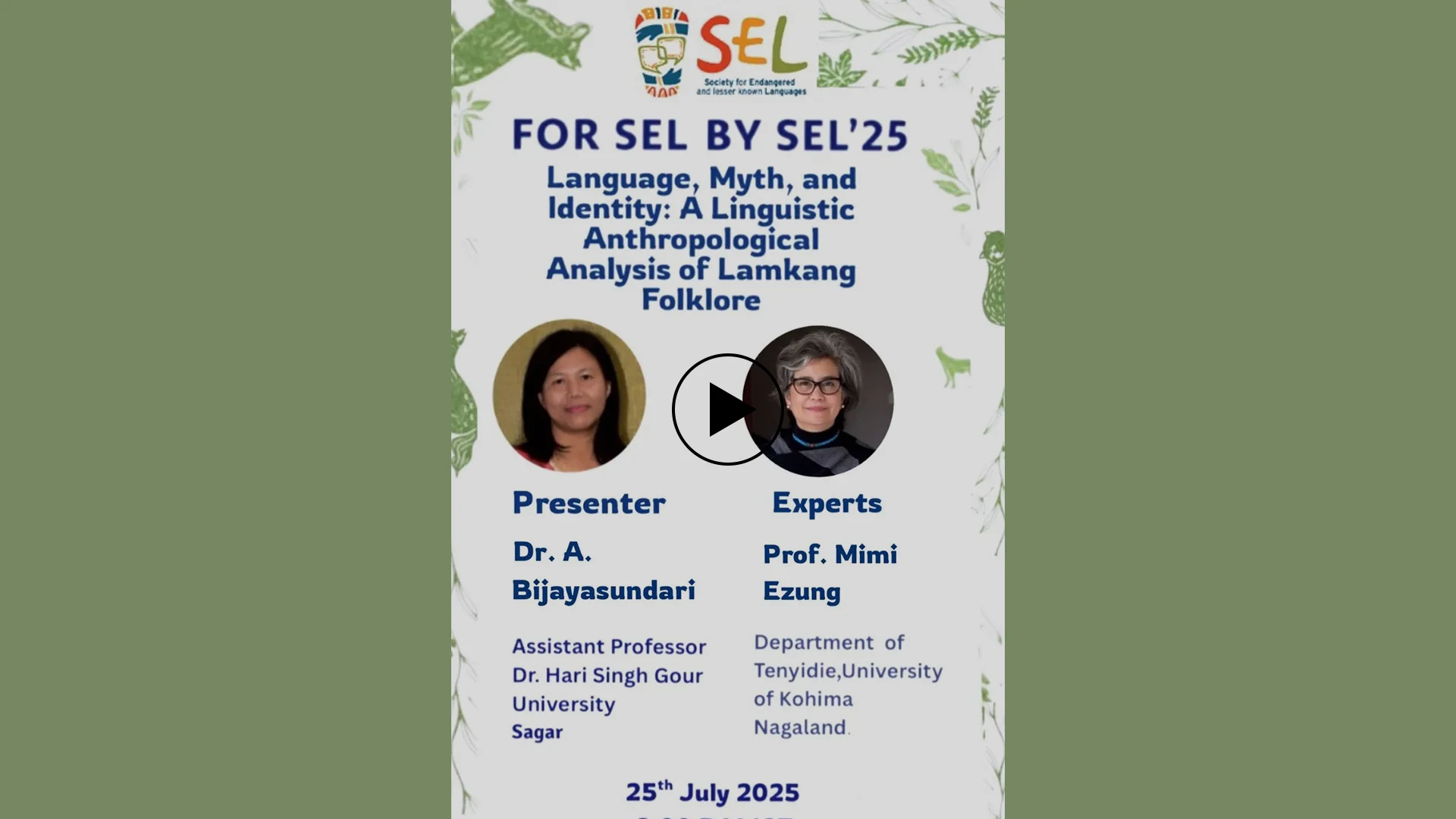
Language, Myth, and Identity: A Linguistic Anthropological Analysis of Lamkang Folklore
This study explores how Lamkang Naga folktales—such as The Boy Who Descended from the Sun—encode cosmology, kinship, and morality. Drawing on ethnographic and archival research within a linguistic anthropological framework, it shows how naming practices and performative speech acts reinforce identity, social order, and memory, underscoring the role of oral traditions in preserving endangered languages and indigenous worldviews.
Watch the Video
Language Mixing in the Contact Varieties of Northern Kasaragod
This study investigates language mixing and contact-induced change in northern Kasaragod’s non-standard varieties. Fieldwork across multiple communities reveals morphosyntactic reorganization in NKV-Malayalam, including selective retention of subject–verb agreement and regional clefting strategies. Lexical diffusion, morphophonological syncretism, and phonological change reflect intense multilingual contact, highlighting the need for targeted documentation and educational initiatives.
Watch the Video

A Pilot Study on the Cognitive Environment of Bhojpuri Idiom
This pilot study investigates the cognitive environment of Bhojpuri idioms, examining how they shape and reflect mental models, cultural values, and collective worldviews. By analyzing idioms in their social and conversational contexts, the study uncovers the interplay between linguistic form, cognitive processes, and sociocultural meaning, offering fresh insights into the structure and function of Bhojpuri as a regional language.
Watch the Video